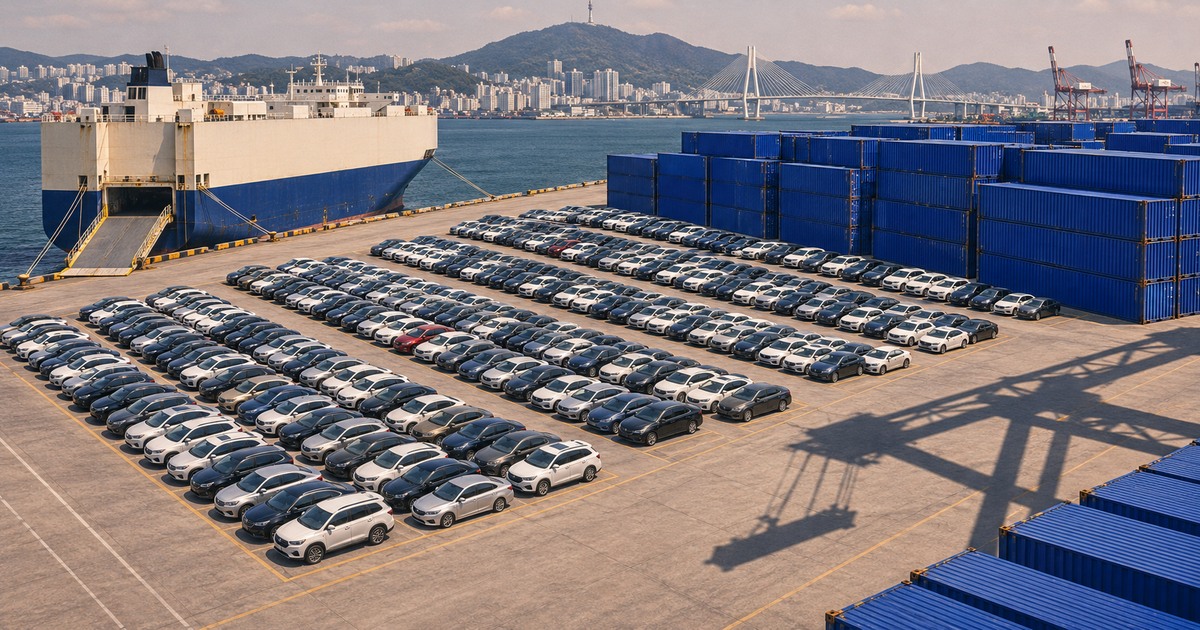
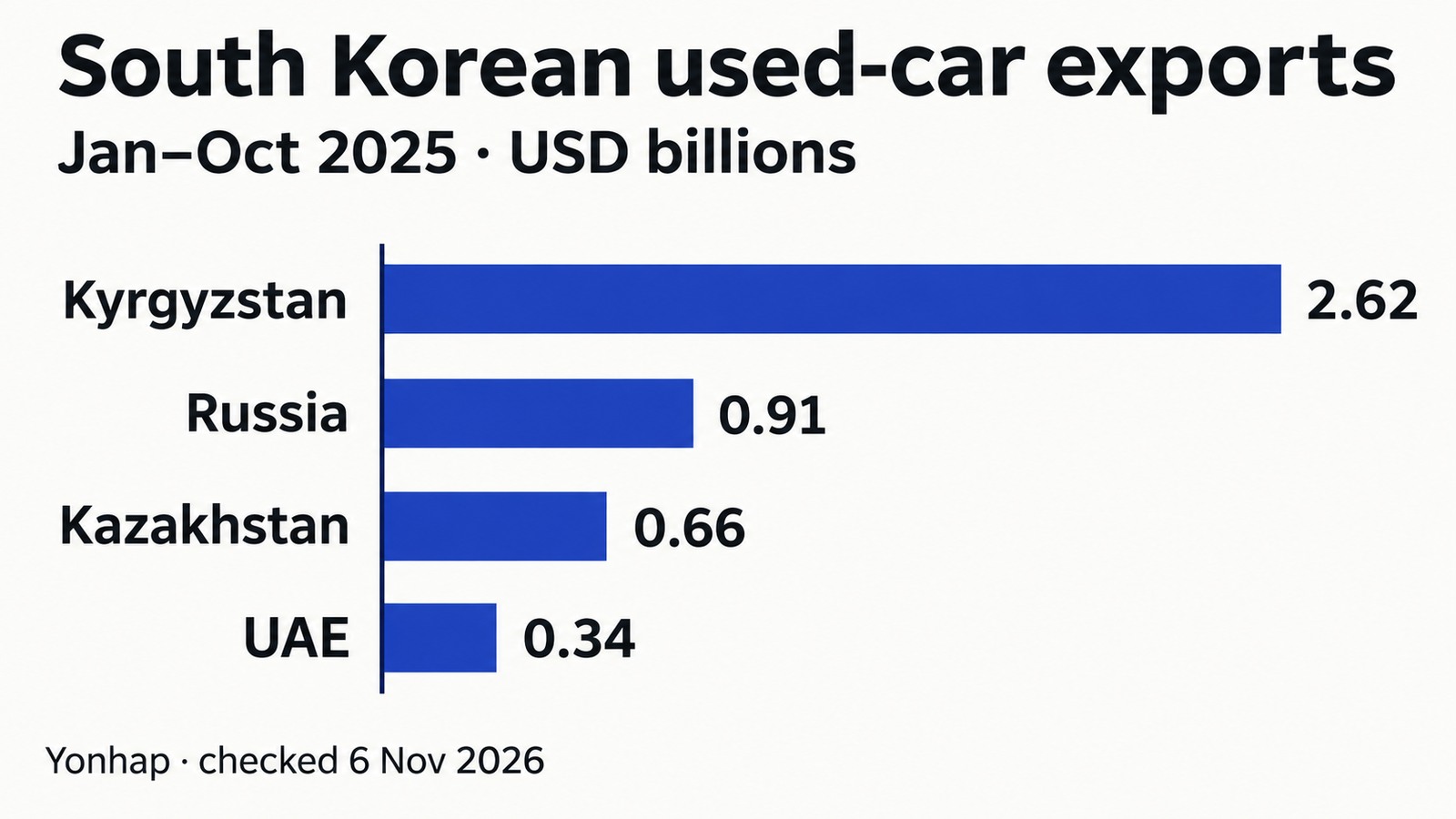
For a dealer deciding which countries a catalog should serve, Korean export statistics offer an unexpected signal. South Korea exported $2.62 billion worth of used cars to Kyrgyzstan in January–October 2025. Russia and Kazakhstan together accounted for about $1.57 billion. Yonhap in The Korea Times, December 21, 2025.
These are export values, not a count of vehicles that stayed in Kyrgyzstan. Part one covers what else the data shows and why export value fell in autumn 2026. Part two shows how a catalog can give a buyer abroad a clear price in their own language.
Exports: what the statistics show
A $1 billion gap in ten months
| Destination | Used-car exports from South Korea, USD millions |
|---|---|
| Kyrgyzstan | 2,623.6 |
| Russia | 909.8 |
| Kazakhstan | 664.6 |
| United Arab Emirates | 337.2 |
Korean-language reports attribute the detailed figures to the trade ministry and the Korea Automotive Technology Institute (KATECH) and also rank destinations by vehicle count for the same period. Libya led with 119,519, followed by Kyrgyzstan with 104,738. Russia was fifth with 43,066. Kazakhstan is outside the published top five, so there is no exact count for the combined comparison. Korea Trade News, republished by KITA, Economy Focus, December 21, 2025.
South Korea is the reporting exporter. The figures show neither how many vehicles stayed for domestic use nor the route of any re-export. That would take local registration or sales data and records for individual vehicles.
What set the record in 2025
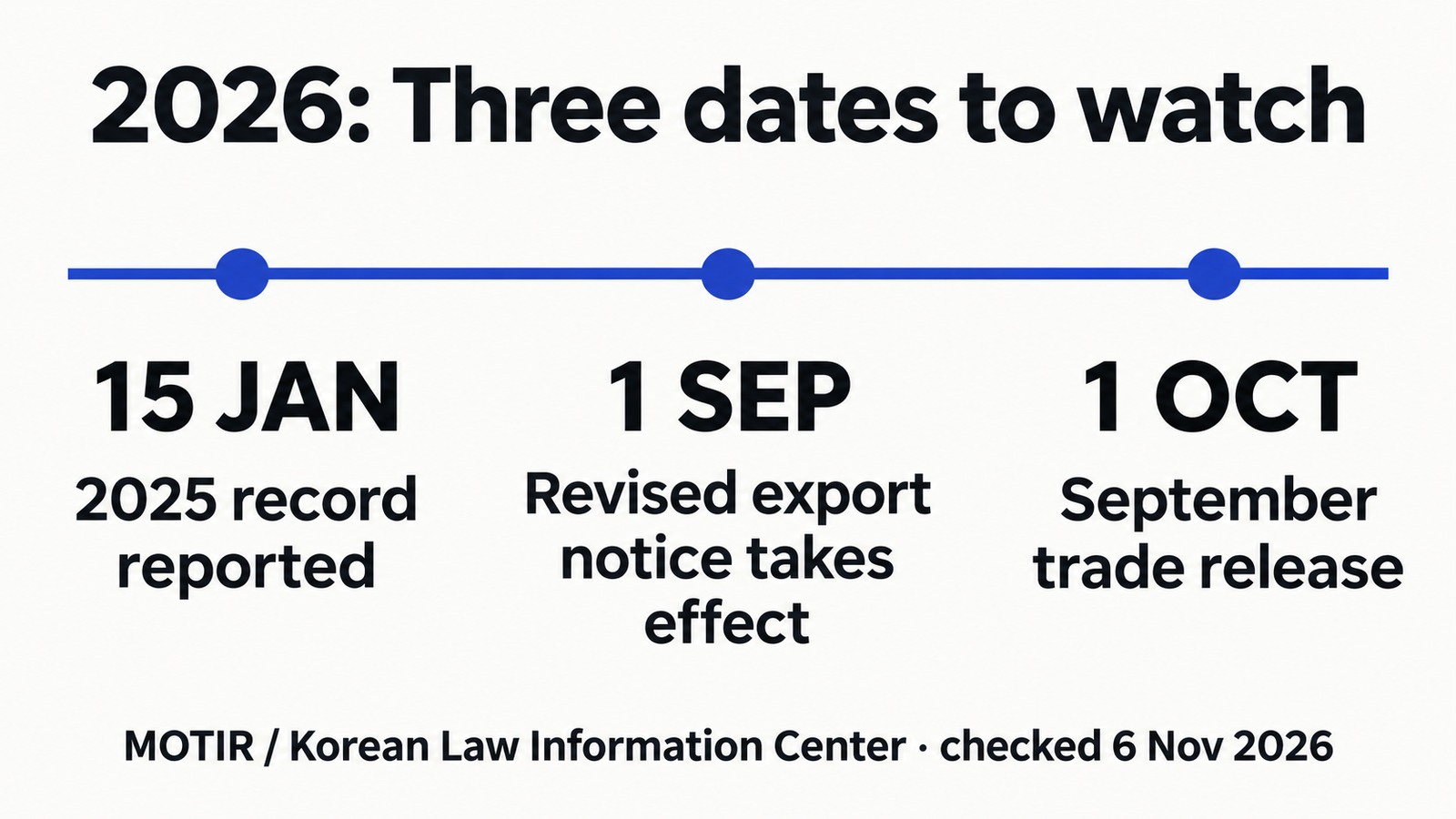
South Korea's Ministry of Trade, Industry and Resources (MOTIR) put the value of used-car exports at $8.87 billion in 2025, up 75.1% from 2024. The same release gives $5.07 billion for 2024 and $4.75 billion for 2023. The 2025 figure represents about 12.3% of South Korea's $72 billion in total vehicle exports by value, calculated from the ministry's rounded totals. MOTIR's annual release, January 15, 2026.
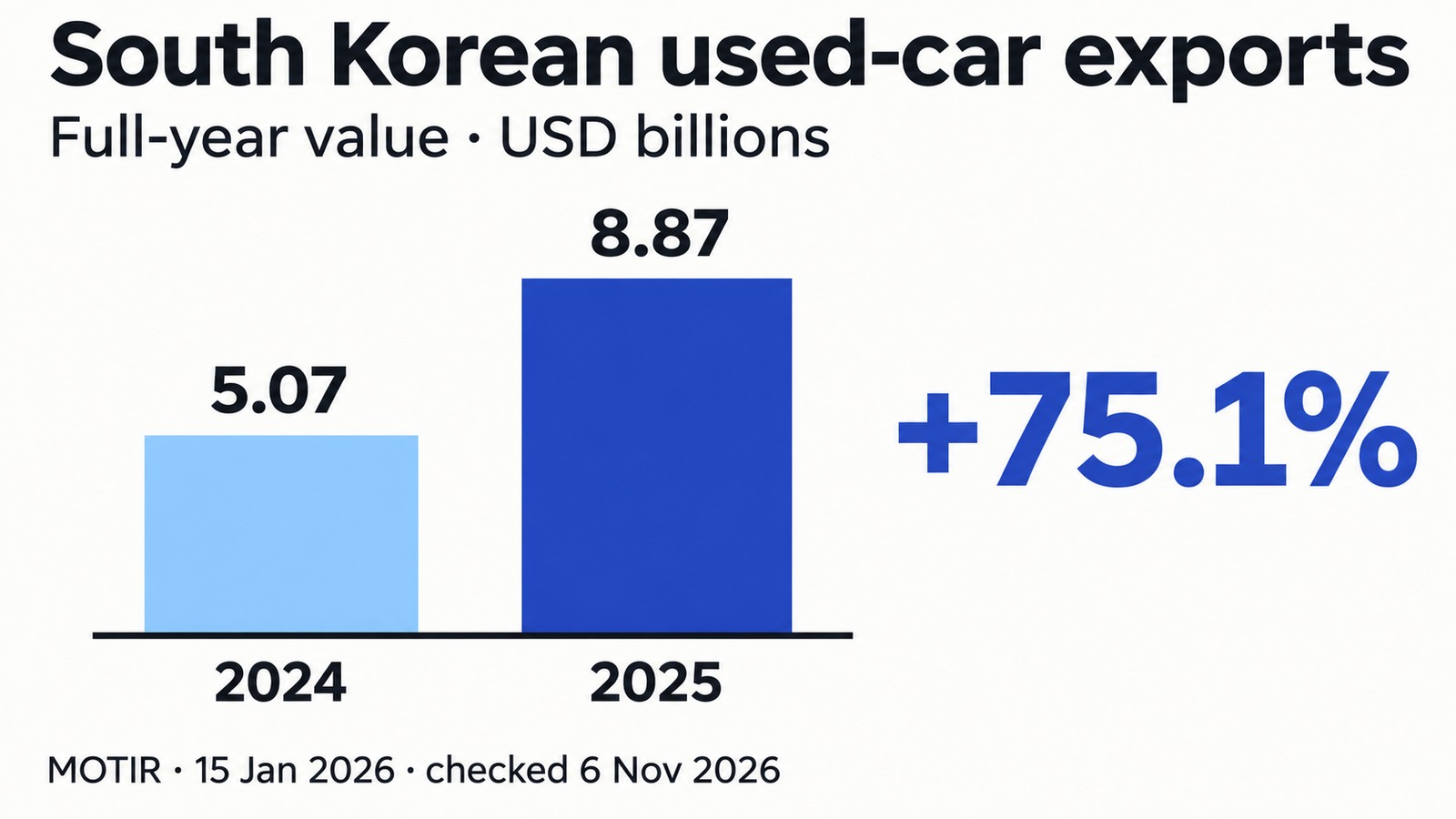
New cars followed a different pattern. Korea JoongAng Daily, reporting Korea International Trade Association figures, put the drop in new-car export value at about 4%. MOTIR cites stronger perceptions of Korean cars and exchange-rate conditions among the factors behind the used-car record, but does not quantify their separate effects. The number of vehicles, the mix of vehicles and their individual values can all move the total. Korea JoongAng Daily, citing KITA, MOTIR.
It is easy to join incompatible tables here. The destination figures stop in October and the national record covers twelve months, so a share calculated from the two mixes periods. The same issue arises with the entire HS 8703 heading, which includes new passenger vehicles. A reproducible customs comparison of used passenger vehicles needs the relevant Korean ten-digit HSK codes, a common period and a quantity field in vehicles. Values in US dollars and net weights in kilograms are separate measures. Korea Customs Service trade statistics, K-stat methodology, Korea Customs Service data definitions.
Export values also use a different price basis from a dealer's quote. Korean customs records exports on an FOB basis. A listing price is a seller's asking price, and an offer to a buyer can add inspection, delivery or insurance on agreed terms. The catalog needs to say which of these figures a customer is seeing and what remains to be priced. Korea Customs Service data definitions.
The 2026 update tells a different story
In September 2026, South Korea exported $450 million in used cars, 56.8% below September 2025, according to the Korean Used Car Exporters Association's summary of MOTIR's trade release. In October, Korean news outlets citing MOTIR reported $480 million, 52.2% below October 2025. The official October release reports $6.55 billion in exports for the entire auto category, up 18.1% year on year. MOTIR September trade release, Korean Used Car Exporters Association, MOTIR October trade release, Newsis, Hankyung.
The ministry points to the Chuseok holiday moving from October in 2025 to September in 2026, which changed the number of working days in both year-on-year comparisons. In April, Korea Customs reported that exporters faced disruptions and higher shipping rates on Middle Eastern services. In May, The Korea Times attributed to KOTRA an estimate that about 30% of South Korea's used-car exports went to the Middle East, with no reference period. We use it only as context and do not apply it to either monthly figure. The September and October values cover all destinations, so a country-level table would be needed to say how Kyrgyzstan's position changed. Korea Customs release archived by KDI, April 24, The Korea Times, citing KOTRA, May 13, MOTIR September auto industry review.
South Korea’s export controls
As checked on November 6, 2026, the Korean Law Information Center lists Notice No. 2026-101 on export and import controls for strategic goods, effective September 1. Korea's catch-all permit regime applies to specified items for export to Russia and Belarus, including certain categories of vehicles. The official YESTRADE guidance says exports of covered items to those destinations are generally prohibited and identifies exceptional cases for individual review. Korea Customs also states that used cars must be deregistered before export. Korean control notice, Foreign Trade Act, Article 19-3, YESTRADE, Article 54 of the notice, Korea Customs export clearance guidance.
What this means for a dealer
Once a destination looks worth exploring and an inquiry comes in, three questions matter.
- Which cars should we show? Start with the models and budgets in your own inquiries, then check the current listings.
- What price can we show? Record the currency, conversion date and what the amount covers for the selected destination.
- What can we confirm about the shipment? Check availability with the seller and have a trade compliance specialist review the transaction against its documents.
Catalog: build around a buyer's request
Below is a catalog design a dealer can test with real inquiries and quotes. Trade figures measure export value; only the dealer's own records show whether the design helps customers get usable quotes.
Listing page and quote
We would keep the listing source, display language and delivery destination separate. Two buyers at the same dealership can work in different languages. If both choose the same destination, they should see the same price basis for the same listing.
The vehicle page shows the listing price, its currency, the date of any conversion and what's included. The quote can then add a destination-specific dealer margin and separately identify confirmed freight, insurance and other applicable charges. Each quote needs a version and a validity period, so a dealer can reopen last week's quote, find the underlying listing amount and see which component changed.
Give buyers identifiable exterior, interior and instrument photos when the source provides them, and keep the original listing link where available. If a listing is stale or has been removed, flag it for the sales team to verify. Store the export review separately: an active listing can still have a pending review. A WhatsApp or Telegram handoff can carry the listing ID, display language and chosen destination.
The same structure makes the dealer's own data easier to read. Visits to the English and Arabic pages point to the same record, and an inquiry carries both language and destination. Sales, quote requests and page views are different events, each with its own denominator. Counted separately, they show where a market is growing and where customers simply switch language.
Map two feeds to one record
Encar and Che168 are examples of listing sources from South Korea and China respectively. The Korean export figures above say nothing about export volumes from China. Combining the feeds gives buyers a common set of fields while keeping the meaning and provenance of each field.
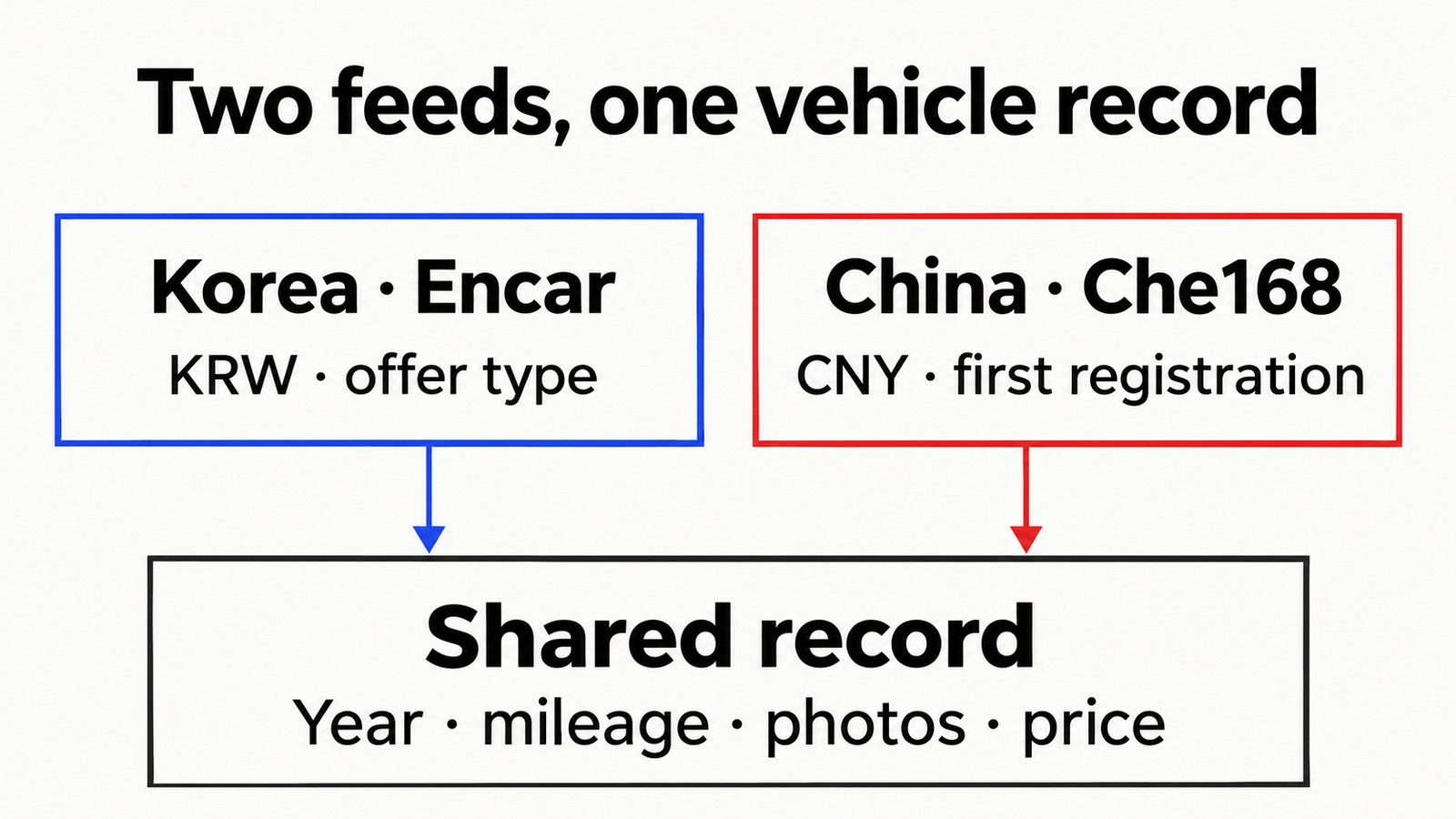
| Field | Encar, South Korea | Che168, China | Catalog treatment |
|---|---|---|---|
| Listing ID | Source listing ID | Source listing ID | Keep the source and ID together |
year and mileage_km | Model year and mileage | Year of first registration and mileage | Display kilometers and mark missing values |
price, price_usd and raw.fx | KRW asking price, USD conversion when available | CNY asking price, USD conversion when available | Label the source currency, conversion date and price basis |
photos | Images supplied by the search feed | Images when supplied by the source | Preserve order and identify missing photos |
raw.sell_type | Offer type when provided | No equivalent in this schema | Check ordinary sale status for the Korean purchase view |
registration_date and model_year | Month of first registration and model year | Month of first registration; model year when the version name has one | Keep them apart: registration is not the build date |
| Transmission, engine size and VIN | Engine size on every combustion car and a VIN on about 7 cars in 10, from the listing card; no transmission | Transmission and engine size may be available | Verify what matters for the deal against vehicle documents |
A matching make and model can still hide differences in trim. We would map spelling variants for search and keep the original trim string for review. Missing data should be shown as missing: a guessed gearbox or a color read from a photograph can silently hide a suitable car or suggest a feature the seller never stated.
Both requests look for listings marked active in the catalog, from model year 2020 and up to $25,000 at the reference rate. Each call covers one source market. Check the Korean offer type after reading each page and use next_cursor to continue.
GET /v1/cars?market=kr&is_active=true&price_usd_max=25000&year_min=2020&limit=100
GET /v1/cars?market=cn&is_active=true&price_usd_max=25000&year_min=2020&limit=100
Make the dollar figure reproducible
For comparison, price_usd converts the listing's asking price using a reference rate. The ECB quotes currencies against the euro. Divide USD per EUR by KRW per EUR, or by CNY per EUR, to get USD per unit of the original currency, then multiply the original amount by that cross-rate. Keep the currency, usd_per_unit, date and source in raw.fx. The ECB publishes these rates for information; a payment or commercial quote may use a different rate and add charges. ECB euro foreign exchange reference rates.
Check one thing before sorting the Korean feed by dollar price. A lease or rental amount may represent only part of the cost. For a purchase view, we would keep Korean records marked raw.sell_type = normal and send records with an unknown offer type for review. If a usable conversion is missing, keep the original amount visible and leave the listing out of dollar-based comparisons until it has a rate.
A quote request should keep the price and rate date the buyer saw, so that a new listing price or conversion can be shown alongside the previous one. Both sides then have a record of the same offer even when the live catalog moves on.
One listing, three ways to read it
The mockup uses one fictional listing, DEMO-12, and one illustrative vehicle price, $18,900. Russian, English and Arabic readers all see the same commercial basis: shipping is excluded. The Arabic layout reads right to left, while identifiers and numeric amounts can stay in their own text elements.
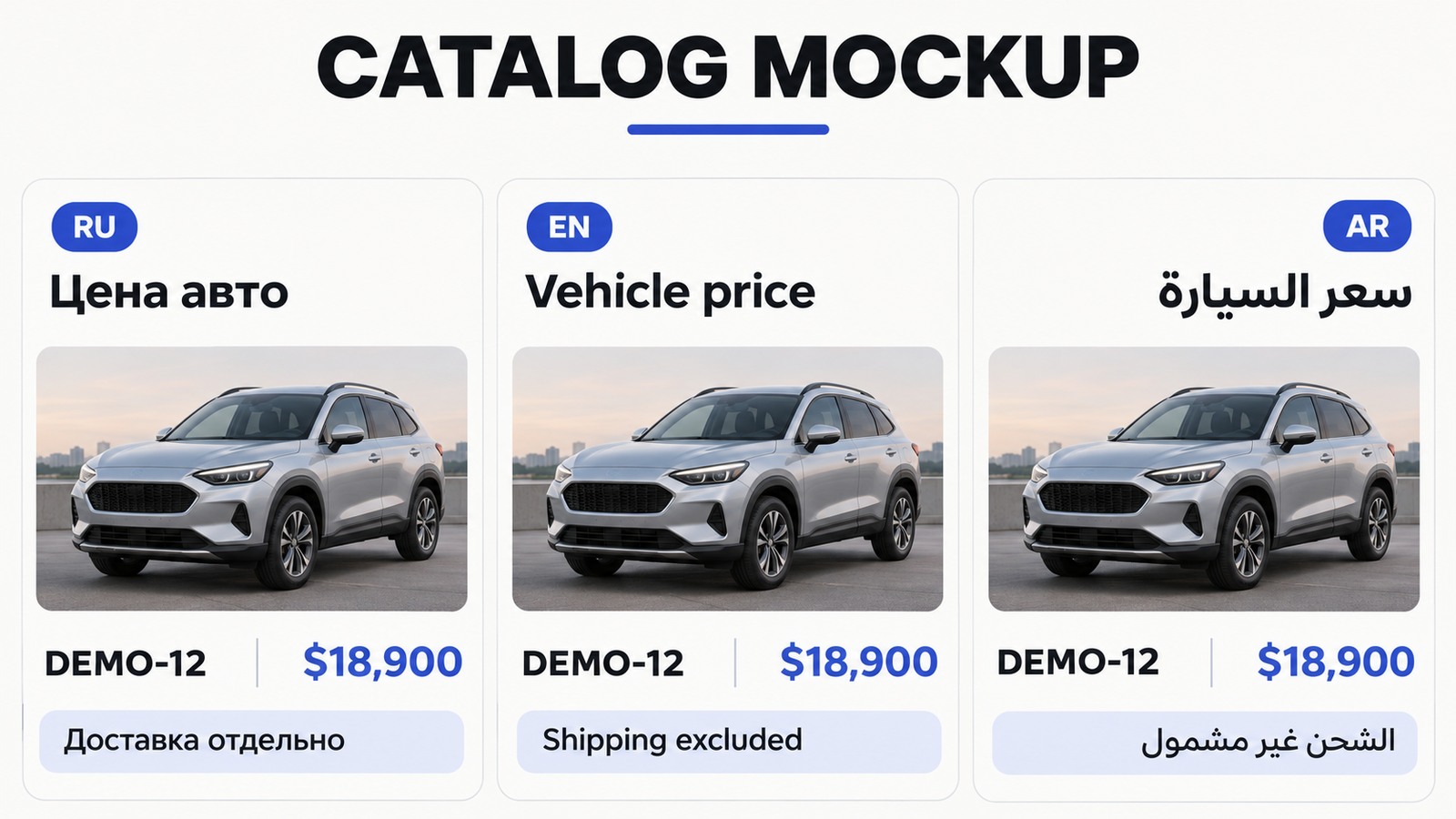
Before launching, we would open a deep link in all three languages and inspect the outgoing inquiry. The vehicle ID and destination should survive the switch, while labels and number formatting follow the locale. Then the same with an unavailable listing, a missing photograph and an unclassified offer. Each case should tell the customer what can be confirmed and give the sales team enough context to follow up.
Export values can tell a dealer which destinations deserve a closer look. An inquiry and quote history can tell the same dealer where to invest in translation, stock selection and local pricing. Which market has grown for you in the past six months, and which signal showed the change first — inquiries, confirmed quotes or completed shipments?